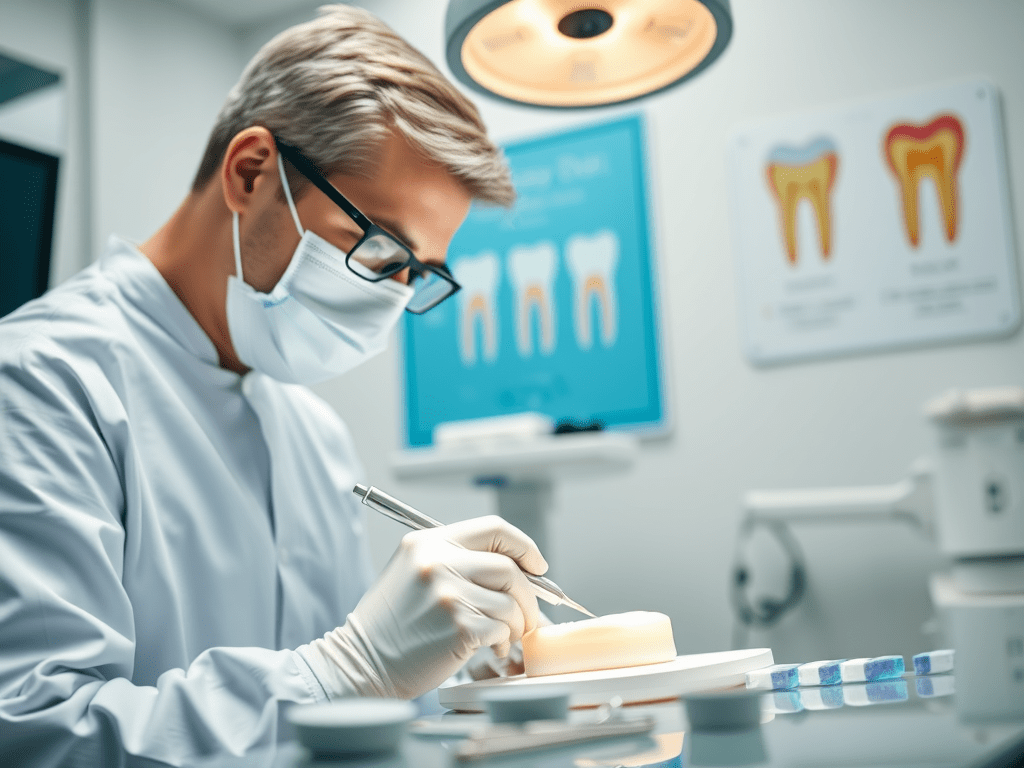
The Importance of Proper Inlay/Onlay Preparation
The success of an indirect inlay or onlay restoration doesn’t come from the ceramic or the cement alone — it comes from the quality of the preparation. The prep dictates retention, marginal integrity, load distribution, and ultimately long-term survival of the tooth-restoration complex. A poorly designed prep will fail no matter how “advanced” the material is.
1. Conservation of Tooth Structure
One of the main reasons we choose inlays/onlays instead of full coverage crowns is to preserve enamel. A correct preparation maintains as much healthy structure as possible, particularly peri-cervical dentin, which is critical for fracture resistance. Over-preparation defeats the entire purpose of doing an indirect partial coverage restoration in the first place.
2. Marginal Integrity and Bond Longevity
Smooth, well-defined internal line angles and a clear, butt-joint margin ensure:
- Better seating of the restoration
- Lower risk of marginal chipping
- Better adaptation of the ceramic or composite to the tooth
- Optimal resin cement film thickness and stress distribution
Any irregularity in the margin = a future problem in the form of marginal discoloration, microleakage, post-operative sensitivity, or secondary caries.
3. Stress Distribution Under Occlusal Load
Onlays in particular must be designed to redirect occlusal forces along the long axis of the tooth. Poor design concentrates stress in the cuspal ridges, leading to:
- Cusp fracture
- Debonding
- Catastrophic ceramic failure
Proper functional cusp coverage and rounded internal geometry significantly increase the biomechanical durability of the tooth-restoration complex.
4. Retention and Resistance Form — through Adhesion
In modern adhesive dentistry, prep design should complement micromechanical bonding. Divergent walls (not convergent like a crown prep) help passive seating of the ceramic during cementation and avoid internal stress buildup. Adhesion provides retention — not taper.
5. Material-Specific Requirements
Different materials (lithium disilicate, zirconia, nanoceramic hybrids) have different thickness and margin design requirements. A precise prep ensures:
- Adequate material thickness to resist tensile and compressive forces
- No sharp internal angles that act as stress concentrators
- Proper emergence profile and esthetics
In short: wrong prep = wrong indication, even if the dentist chooses the “right material.”
Bottom Line
A well-executed inlay/onlay preparation isn’t “just shaping the tooth.” It is a biomechanical design decision. The prep controls:
| Outcome | Determined by prep? |
|---|---|
| Strength of restoration | ✅ |
| Longevity of adhesive interface | ✅ |
| Preservation of tooth vitality | ✅ |
| Marginal seal | ✅ |
| Risk of fracture | ✅ |
| Esthetics | ✅ |
If the preparation is wrong, everything built on top of it will eventually fail — no bonding system or CAD/CAM material can compensate for fundamental biomechanical shortcomings.
 My life in Dentistry by Dr. Porto
Leave a comment